



The agentic system for product innovation

Where product managers turn problems into undeniable opportunities.

In the age of AI, it's never been easier to build the wrong thing. Ainna solves that: bring a hunch, a problem, or your roadmap's next bet. Ainna frames the problem, sizes the market, maps the competition, and puts the case on trial — the AI Judge scores it, the experts you invite challenge it. In minutes you get the verdict, a framed opportunity, and the deck, PRD, and one-pager to present it.

Pressure-test your first idea.

Free to try · No credit card · Your ideas are never used to train AI

Your opportunity portfolio

High-potential opportunities

Discovered by Ainna and the domain experts you trust.

01 Problems worth solving A hunch, a thesis, a half-formed concept. Bring it as it is; Ainna meets it there — and works it down to what's actually worth solving.
02 Potential solutions A structured conversation forces clarity on the solution: who it's for, how it works, why now.
03 Framed opportunities Market sized, competitors mapped, personas profiled. The evidence stakeholders ask for, ready before they ask.
04 Assessed opportunities The Judge scores viability, feasibility, and desirability — then the people you trust weigh in. Deciding isn't a solo call.
05 Prioritized opportunities It earns its place in your portfolio — ranked against every other bet, with the deck, PRD, and one-pager to back it. Yours forever.
How It Works

Problems in.
Prioritized opportunities out.

A loop you run for every problem worth solving — and the strongest opportunities land in your portfolio.

Frame

Start with the problem

A structured conversation that gets the problem right before anyone reaches for a solution — who it hurts, why it matters, why now.

A problem worth solving, clearly framed
Prioritize

Route the winners

Rank the high-potential opportunities against each other and send each to the right portfolio — with the deck, PRD, and one-pager to back it.

Ranked opportunities, in the right portfolio
Brainstorm

Generate, then go deep

Open up the solution space, then frame and develop the ideas worth pursuing — from raw concept to a structured opportunity.

Promising solutions, developed into opportunities
Assess

Put it on trial

The Judge scores viability, feasibility, and desirability. The Panel brings the domain experts you trust into the evaluation — AI analysis meets human judgment.

Scored by Ainna, validated by your experts

No credit card needed · Free to try

THE FRAMING ENGINE

From rough ideas to real opportunities.

Take it deep — framed, the market sized, the personas mapped — until it can stand up to the Judge and the experts you trust. Then turn the work into a deck, a PRD, or an opportunity ranked in your portfolio.

01 Frame

Your idea, framed.

Guided conversations that force clarity. Ainna helps you articulate what the product actually is, who it's for, why now, and the risks or uncertainties you have to address first.

Product Framing Problem, user, solution, and 'why now' — structured and challenged
Brainstorming Mode Systematic exploration of adjacent possibilities and solution spaces
Interactive Framing Talk through your idea like you would with a sharp colleague. Ainna listens, challenges, and builds structure around your thinking.
Ainna core idea view showing the framed product concept — problem, user, solution, and why-now structured in one place
02 Assess

Your idea, on trial.

The Judge scores viability, feasibility, and strategic fit. The Panel brings in the people whose opinion actually matters: advisors, domain experts, target users, each evaluating independently. AI rigor, human judgment, one verdict you can stand behind.

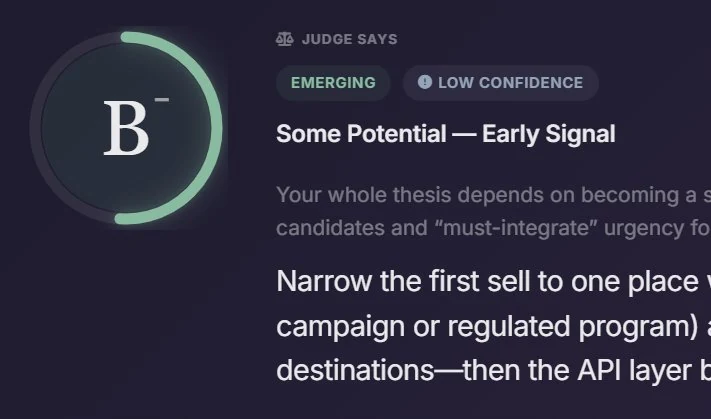
The Judge AI-driven opportunity scoring across viability, feasibility, desirability, and strategic fit
The Panel Unique to Ainna — invite domain experts, advisors, or target personas to independently evaluate and challenge the assessment
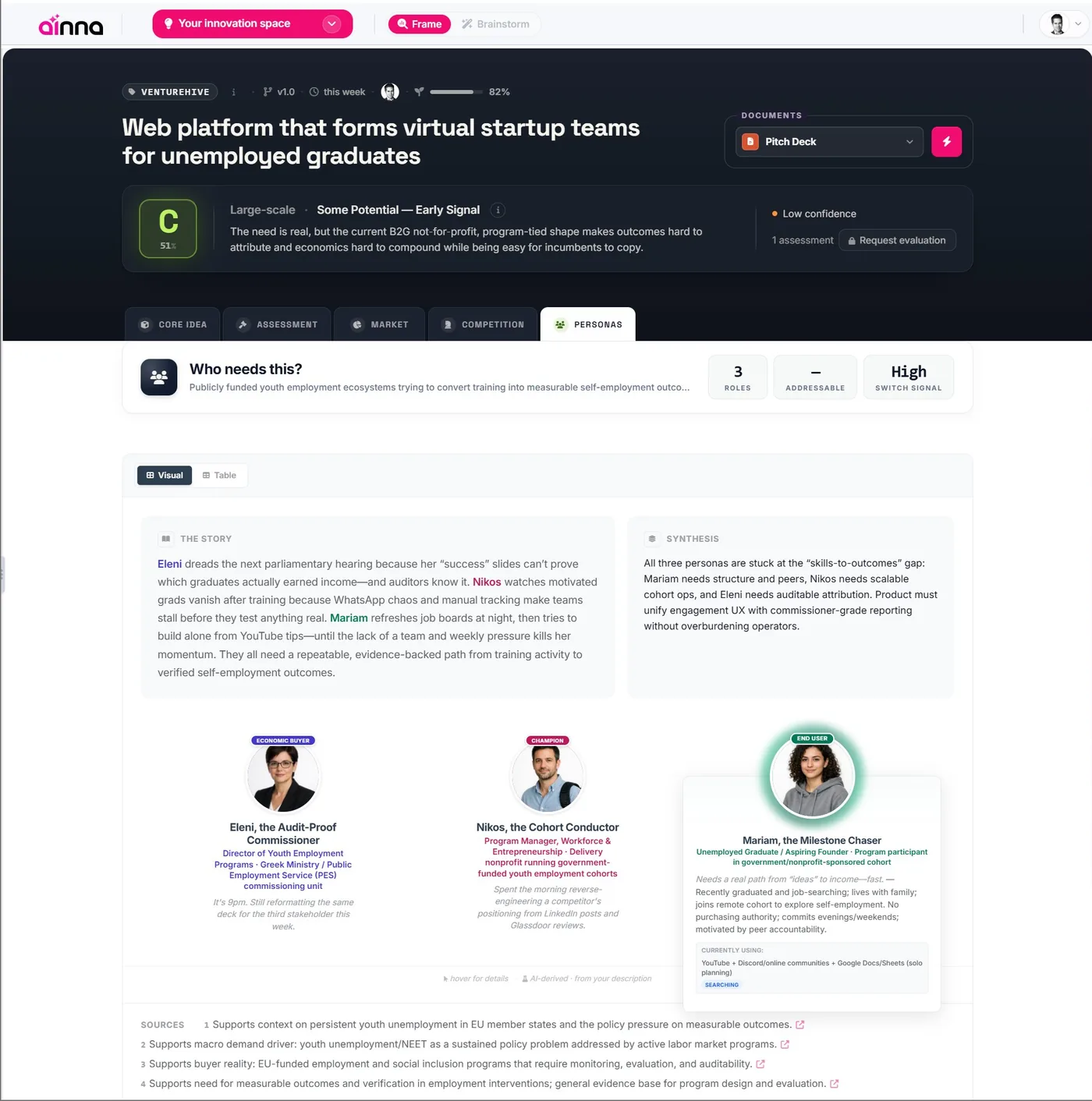
Persona Deep-Dive User stories, pain hierarchies, and the motivational architecture behind adoption
Persona Assessment Run your opportunity through the lens of each persona — surfacing fit gaps and adoption risks
Ainna assessment view highlighting the Judge — structured scoring of viability, feasibility, and strategic fit
03 Analyze

Your market, mapped.

Your competitors are already out there. Ainna shows you exactly where — and where they aren't. Size the market with transparent assumptions, surface the positioning gaps, and find the whitespace before you commit. The deeper you dig, the harder the case is to argue with.

Competitive Mapping Who’s already there, what they’re missing, and where the whitespace is
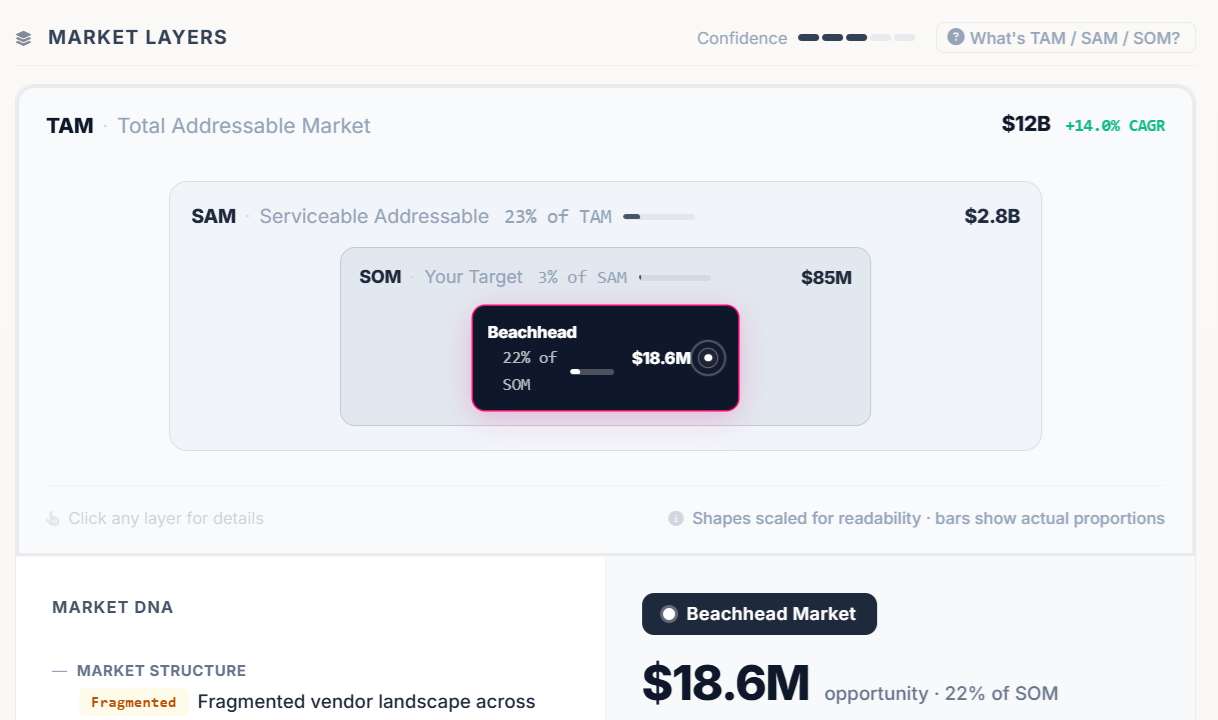
Market Sizing Real numbers with transparent assumptions — not optimistic guesswork
Positioning Gaps Where your product has room to win — grounded in evidence, not aspiration
Ainna competitive landscape analysis showing market positioning map and differentiation opportunities
04 Communicate

Your case, packaged.

Every conversation, every assessment, every refinement — synthesized into branded documents that are fully yours to edit and share. Different stakeholders need different stories; Ainna builds each from the same body of work. And the opportunities worth keeping don't just leave as documents — they take their place in your portfolio.

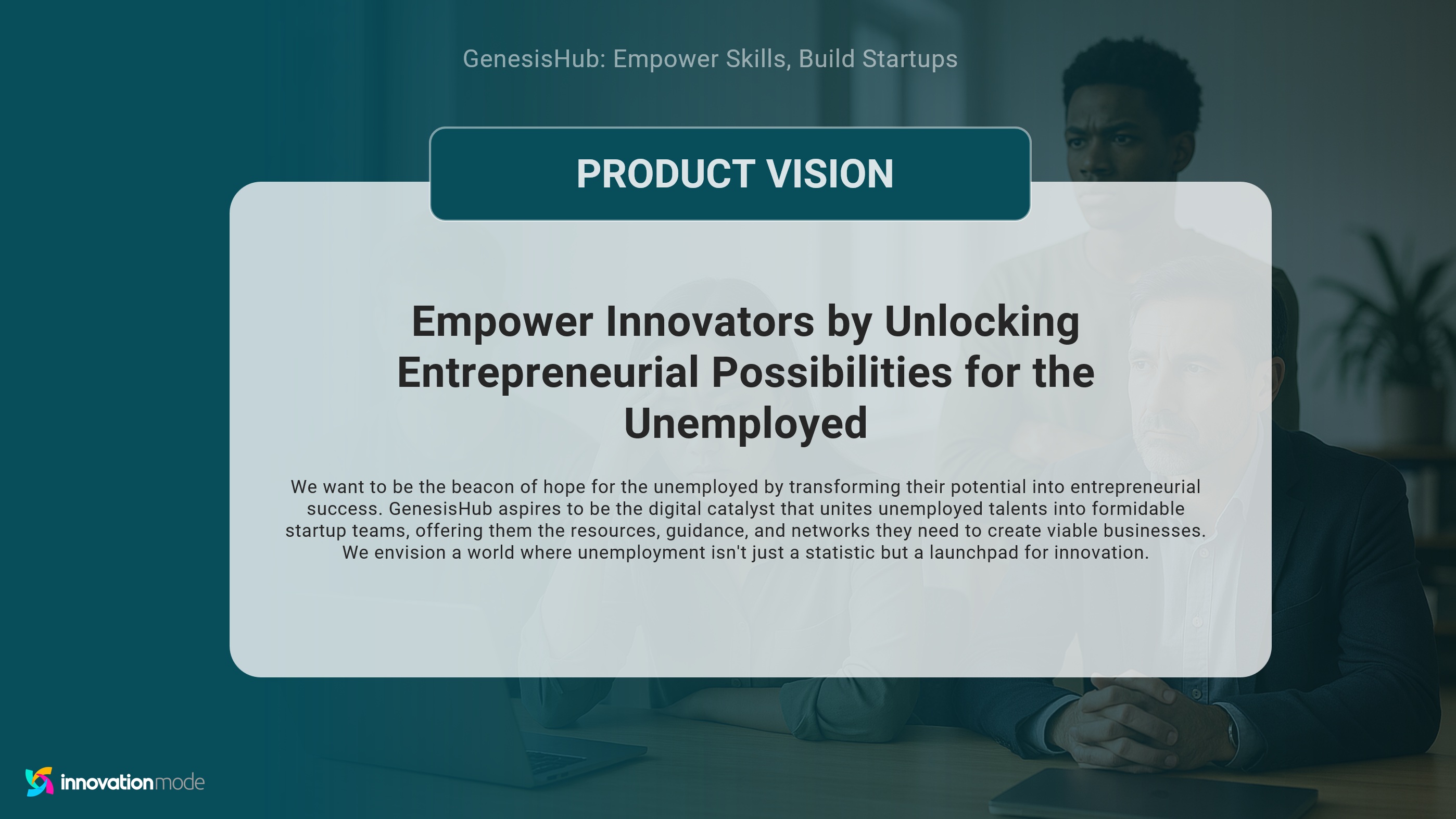
Pitch Decks Pixel-perfect, themed, and branded — structured to tell your opportunity’s story from problem through solution to market proof.
Product Requirements Comprehensive PRDs with technical specs, user journeys, and implementation roadmaps — structured for engineering handoff.
Executive Summaries One-pagers and strategic briefs tailored to leadership, investors, or engineering
Your Brand, Applied Your logo, company name, and identity on every document — fully yours to edit and distribute.
Into Your Portfolio Route the high-potential opportunities into a portfolio you can rank, compare, and revisit as the market moves.
Ainna document generation showing pitch deck, PRD, and executive summary outputs with company branding
Pricing

Set up your opportunity pipeline.

Transparent pricing. Subscribe monthly to stay flexible, or prepay annually and save up to 25%.

Core

Founders exploring ideas, PMs validating a new bet, hackathon teams
$149
8 product concepts to frame per month
Save 15% with annual billing
Features Brainstorming Mode Interactive Idea Framing The Judge Personas Market Outlook Competitive Landscape
Documents Pitch Deck Idea One-Pager Problem Framing Document Problem Framing Deck Product Requirements Document (PRD) Product Requirements Deck

Scale

For innovation leads, senior PMs managing multiple bets, portfolio owners
$899
50 product concepts to frame per month
5 seats · $179.80 per person/month Save 25% with annual billing
Features Brainstorming Mode Interactive Idea Framing The Judge Personas Market Outlook Competitive Landscape The Panel Branded Documents Themed Decks Pivot History
Documents Pitch Deck Idea One-Pager Problem Framing Document Problem Framing Deck Product Requirements Document (PRD) Product Requirements Deck Patent Draft Accelerator Jira Product Backlog

Start with a free trial

Three ways to subscribe — monthly to stay flexible, annual prepaid to save up to 25%, or a custom enterprise agreement for organization-wide deployment. Every plan unlocks the full system and a set number of product concepts you can frame in depth each month — opportunity assessment, market sizing, personas, and competitive landscape.

Frequently Asked

Everything you need to know

An AI-native innovation system runs corporate innovation as a continuous, always-on function rather than a one-off event — using AI agents to discover, assess, and develop opportunities across an entire organization. It spans the three capabilities every innovation program needs: opportunity discovery (turning ideas and market signals into framed, scored opportunities), validation (testing them against real-world evidence), and realization (building the ones that earn it).

Ainna is an AI-native innovation system built on the Innovation Mode methodology. Anyone can bring an idea; an AI evaluator scores it against a structured model; the human experts you trust stay in the loop; and the strongest opportunities surface into a live portfolio, each with the deck, PRD, and business case attached. It isn't a chatbot and isn't a slide generator. It's the system that turns raw thinking into decisions you can defend.

You start a conversation, and the system does the structured work. Bring a hunch, a problem, or a half-formed concept; Ainna frames the problem, sizes the market, maps the competition, profiles the personas, and assesses the result — producing an Opportunity Score and a narrative that explains the strengths, the risks, and the recommended next step. What took an innovation team weeks now takes minutes.

The score isn't the finish line. The experts you invite assess the same opportunity independently, you iterate as your thinking sharpens, and what survives becomes a defensible case — with the pitch deck, PRD, and one-pager to back it. What doesn't survive fails here, where failure is cheap.

Agentic AI for innovation means AI that doesn't just answer prompts but acts — perceiving signals, making assessments, and taking steps through the innovation process on its own. Applied to corporate innovation, agentic AI can continuously scan for opportunities, frame and score ideas as they arrive, orchestrate independent assessments, and route the strongest concepts to the right team — running always-on instead of waiting for the next workshop.

Inside Ainna this shows up today: an AI evaluator scores each opportunity against a structured model and writes its narrative, AI personas can pressure-test an idea from an investor's or a customer's point of view, and the system surfaces where assessments disagree so humans can resolve it. The agents handle the scale and the speed; people decide what's worth fighting for. This is the shift set out in Innovation Mode 2.0, the methodology Ainna is built on.

Every opportunity gets a single Opportunity Score, built from four lenses every product leader recognizes — viability, feasibility, desirability, and strategic fit — that in turn roll up nine underlying dimensions: importance of the problem, strategic alignment, effectiveness of the solution, feasibility, ease of implementation, ease of operation, business impact, novelty, and certainty of demand. Each is scored with a justification, so the number always comes with the reasoning behind it.

The score is produced by an AI evaluator and then enriched by the human experts you invite, who assess the same opportunity independently. The result is an Opportunity Narrative — not just a grade, but a defensible account of where the idea is strong, where it's weak, and what to do next. The model is configurable: a product team and an IP team can weight the dimensions differently, because what matters depends on the decision you're making.

The trustworthy unit isn't the AI alone — it's Ainna plus the domain experts you bring. We hold to the human-in-the-loop principle by design: an AI evaluator scores each opportunity and writes its narrative, then the experts you invite — co-founders, advisors, specialists, even target customers — assess the same opportunity independently. Where their judgment and the AI's diverge, the system surfaces the disagreement rather than smoothing it over.

We've built a deliberate process around that combination, because real wisdom comes from AI's speed and consistency working with human context and judgment — not from either on its own. The AI is the analyst; you and your experts are the decision-makers. That principle is the spine of the Innovation Mode methodology.

A general-purpose chatbot is one small piece of the puzzle. It gives you ideas and prose — maybe a tenth of the work — then leaves you to be the strategist, the analyst, the formatter, and the reviewer. Ask it to size a market and you get plausible numbers with no method; ask for a competitive map and you get a list, not an assessment.

Ainna runs the whole method. It sizes the market against a defensible model, scores the opportunity on a structured framework, maps the competition, profiles real personas, brings human experts in to challenge the result, and hands you a branded pitch deck, PRD, and one-pager you own outright — from one body of work, in minutes. Generic AI reacts to your prompts. Ainna runs corporate innovation end to end, built on a published methodology that knows which questions to ask and which assumptions to break.

Innovation Mode is a structured methodology for running corporate innovation as a disciplined, repeatable function — from spotting opportunities, to validating them with evidence, to building the ones that earn it. It's set out in Innovation Mode 2.0, published by Springer Nature, and it's the framework Ainna is built on rather than a thin layer over a language model.

In practice it gives the work a backbone: a structured way to frame problems, a multi-dimension model for scoring opportunities, a human-in-the-loop principle so AI augments judgment instead of replacing it, and a portfolio view that lets the strongest ideas compete on consistent criteria. Anyone can wrap an AI in a prompt. A proven, published innovation system is what makes the output rigorous — and hard to replicate.

Ainna is for anyone who has to turn an idea into a decision someone will act on — and, more broadly, for any company that wants to stay competitive by innovating faster than it used to. That includes product managers building the case for what to build next, founders validating a concept before they commit time and money, and innovation leaders who need a steady flow of well-framed opportunities instead of a once-a-quarter scramble.

What unites them is the same need: rigorous thinking at speed, without a six-figure consulting budget or weeks of waiting. If you're framing a problem, weighing an opportunity, or preparing something stakeholders will scrutinize, Ainna is built for you. It scales from a single person with one idea to an entire organization running innovation as a function.

An idea is worth building when it solves an important problem, for a real and reachable user, in a way you can actually deliver, with enough demand and strategic fit to matter — and the only way to know is to assess it honestly before you commit. Most ideas fail not because they were bad, but because they were never properly framed, or were judged in the wrong context by the wrong people.

Ainna gives you that honest read fast. It frames the problem, sizes the market, maps competitors, and produces an Opportunity Score across viability, feasibility, desirability, and strategic fit — then the experts you trust weigh in. You get a clear signal: take it forward with evidence behind you, or pivot before you've spent real resources on the wrong bet.

You don't need a template — Ainna generates the PRD for you, formatted and visual, from the work you've already done. Once an opportunity is framed and assessed, it produces a complete Product Requirements Document as an editable DOCX: the problem and goals, target personas and user journeys, requirements, and an implementation outline, laid out with your branding and contextual visuals rather than a blank outline you have to fill in.

The same body of work also yields the pitch deck and the one-pager, so the story stays consistent across every format. Everything exports fully editable and yours to keep — bring your own judgment to the numbers and claims, and it's ready for stakeholders. A static template gives you a shell; Ainna gives you the substance, already written.

Pricing is simple and transparent. Paid plans start at $149 per month, every plan includes the full platform — the strategic conversation, scoring, the human Panel, and all document generation — and annual billing saves up to 25%. There are no hidden fees and no lock-in; larger organizations can move to a custom enterprise agreement.

An opportunity (or product concept) is one idea taken all the way through the process — framed, reviewed, enriched, and assessed into a complete 360-degree view, with the analysis and documents that come with it. Your plan sets how many opportunities you can take to that depth each month. Brainstorming and exploring ideas, though, is always unlimited on every plan — you only commit an opportunity when you're ready to go deep.

You own everything — 100%, forever. Your ideas, your analysis, and every generated document and deck belong entirely to you, fully editable, to use for any purpose: investor pitches, internal alignment, team templates, anything. There's no lock-in.

On privacy, the answer is equally direct: your content is never used to train AI models, never shared with other users, and never sold. Data is hosted in EU data centers under GDPR. Generated documents are kept for 30 days and can be regenerated anytime from your saved work; the rest stays as long as your plan is active and is then deleted after notice and a grace period. You can export anytime and hard-delete in one click. That privacy is deliberate — people think more freely when half-formed ideas aren't being stored or studied.

Yes — and you should bring a real problem, not a toy one. The free trial gives you the full strategic conversation, a real Opportunity Score from the AI evaluator, and document previews, with no credit card required. This isn't a demo running on sample data; you frame your own idea and see exactly how it holds up.

Start with a rough concept and let Ainna drive the framing, or hand it something you've already been chewing on and watch it get sharper. When you're ready for the full document engine and the human Panel, pick the plan that fits — and everything you created on the trial is still there.

FIELD NOTES

Build the right thing.

Guides on opportunity, validation, and the rigor that separates real bets from expensive guesses.

Strategy starts before the first line of code

Ainna helps startup founders and product teams turn rough ideas into validated opportunities. Our guides explore the thinking behind the platform: What Do Product Teams Need to Know About AI Engineering?, How Does AI Transform Brainstorming and Ideation?, What Are the Essential Innovation Terms Every PM Should Know?, How Is AI Transforming Innovation Events?, How Do You Validate a Startup Idea Before Building?. Built on The Innovation Mode — a methodology shaped by 25 years of innovation work across five industries and fifteen markets.

Not ready to dive in? Stay sharp.

One insight per week. No fluff. Unsubscribe anytime.

What Do Product Teams Need to Know About AI Engineering?

What Do Product Teams Need to Know About AI Engineering?

Comprehensive FAQ guide covering AI engineering fundamentals for product teams. Topics include: AI vs ML vs deep learning distinctions, types of AI models (LLMs, vision, speech), key technologies and frameworks, development tools and platforms, MLOps processes, deployment considerations, costs, ethics, and practical guidance for building AI-powered products.

Read the guide
How Does AI Transform Brainstorming and Ideation?

How Does AI Transform Brainstorming and Ideation?

Comprehensive FAQ guide on how AI transforms business brainstorming and ideation. Covers: the shift from blue-sky ideation to synthesis sessions, the AI Ideator as an active participant in brainstorming, the Workshop Designer for automated session setup, AI as real-time facilitator (listening, capturing, generating, visualizing, prototyping on connected screens), how AI processes and preserves ideas through the Innovation Graph, the risks of overreliance on AI-generated content, preserving human creativity alongside AI, running bionic brainstorming as a repeatable organizational capability, and practical guidance for introducing AI into ideation.

Read the guide
What Are the Essential Innovation Terms Every PM Should Know?

What Are the Essential Innovation Terms Every PM Should Know?

Comprehensive glossary of innovation and product development terminology grounded in the Innovation Mode methodology. Defines innovation as 'value through novelty' - the successful implementation of new ideas that create tangible value. Covers core concepts (innovation types, MVP, PMF), methodologies (Agile, Lean, Design Thinking), the Innovation Mode framework (Opportunity Discovery, Opportunity Validation, Opportunity Realization, Nine-Dimension Idea Assessment Model, Innovation Graph, Workshop Designer), organizational models (centralized/decentralized innovation, Innovation Function), experimentation practices (hackathons, rapid prototyping, business experiments), and business analysis terms (TAM, business model innovation). 50+ definitions in total.

Read the guide

Reconnecting

Your strategic session is being restored.

Still reconnecting

This is taking longer than usual. Your work is safe.

Connection lost

We couldn't restore the connection. Your work has been preserved.

Session expired

Your session has ended. Reload to continue where you left off.